Process Development
Lab to Pilot to Scale
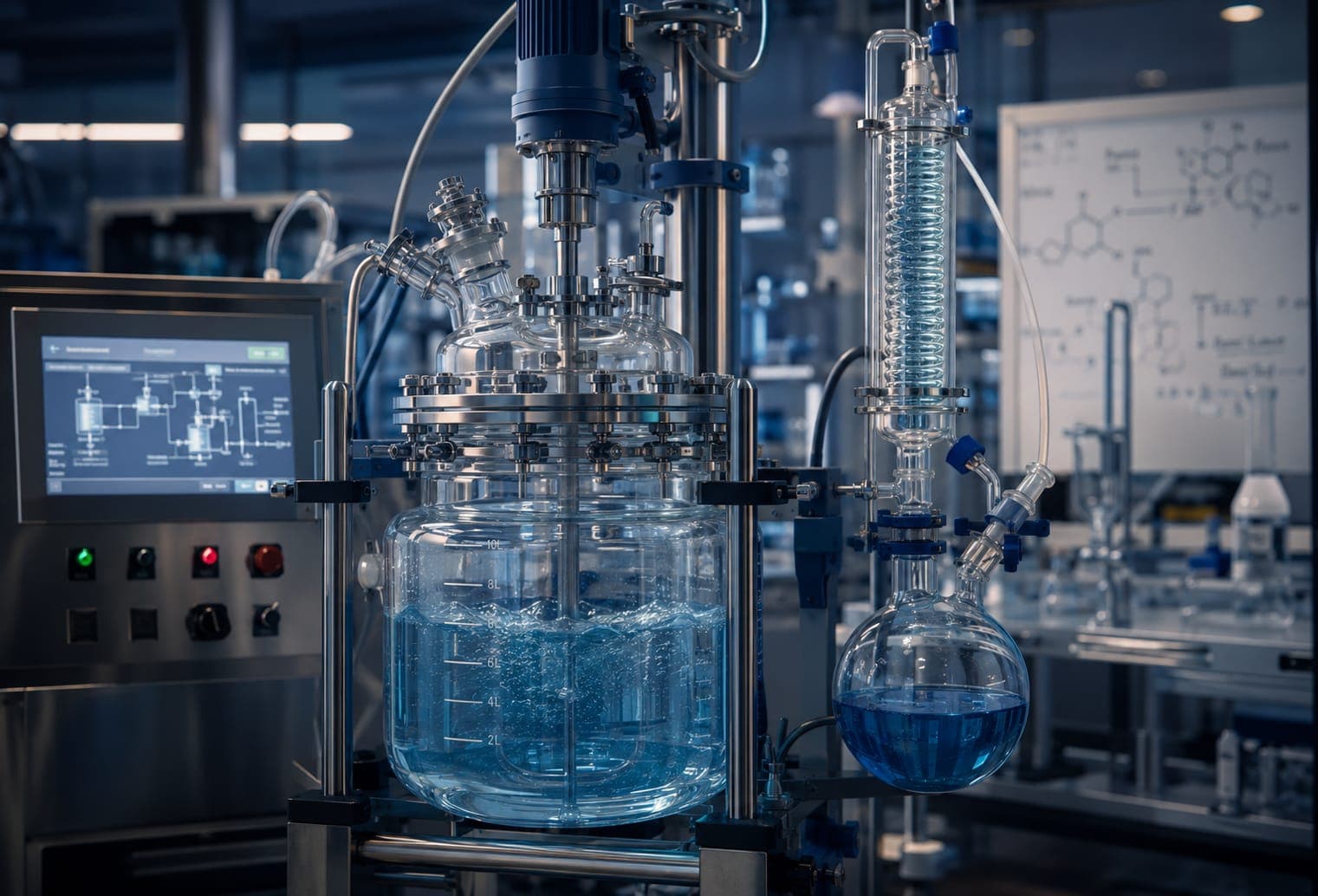
Route optimization and scale-up through 100L, 250L, and 500L pilot units — the same team that develops the route runs the scale-up.
A route that works at bench scale doesn't automatically work at 100 kg — yield, impurity profile, exotherm control, and workup all behave differently once volumes go up. Sparge Chem's process development group takes a validated bench route and re-engineers it for pilot and production scale, using the same 100L, 250L, and 500L pilot reactors for every client program, not a separate outsourced scale-up step.
Process development work at Sparge Chem covers reaction optimization (temperature, solvent, catalyst loading, stoichiometry), impurity control, workup and isolation redesign for larger volumes, and — where GMP production is the end goal — the transition from non-GMP process development into our GMP facility for regulatory-grade manufacturing.
This is the same discipline behind our largest scale-up to date: Letermovir intermediate synthesis taken to 600 kg in the GMP facility (99.5%+ purity), alongside process development for quinoline derivative intermediates, Zavegepant intermediates, and Bemnifosbuvir — each a different route re-engineered for scale, not a repeat of the same chemistry.
What's included
Route re-engineering for scale
Reaction and workup steps that are fine at gram scale are redesigned where they won't hold up at kilogram-plus — exotherm management, addition rates, and mixing all get re-assessed, not just scaled linearly.
100L, 250L, and 500L pilot units
Three pilot reactor volumes on site, so a process can move from bench to intermediate pilot scale before committing to the largest run.
Impurity control at scale
Process-related impurities that only appear above a certain batch size are identified and controlled during scale-up, not discovered after a full-scale run.
GMP and non-GMP process tracks
Development work can run in the non-GMP facility while the process is being finalized, then transition into the GMP facility for regulatory-grade production runs — without changing vendors mid-program.
Sustainable process chemistry
Solvent selection, atom economy, and waste stream reduction are part of route optimization, not an afterthought applied only when requested.
How it works
Bench route review
We review the existing bench-scale route (yours or one we've developed under custom synthesis) for scale-up risk: exotherms, cryogenic steps, unstable intermediates, filtration/workup bottlenecks.
Process optimization
Reaction parameters are optimized for the target scale — solvent volumes, addition rates, temperature control, catalyst loading.
Pilot-scale runs
The optimized process runs through 100L, then 250L or 500L as needed, with full analytical monitoring at each scale-up step.
GMP transition (if required)
For regulatory-grade material, the validated process transitions into the GMP facility for production runs.
Track record
600 kg GMP scale-up, 99.5%+ purity
Letermovir intermediate synthesis scaled to 600 kg in our GMP facility and 50 kg in the non-GMP facility, at 99.5%+ purity — our largest scale-up to date and the clearest evidence of what this group can take from lab to production.
Quinoline derivative, Zavegepant, and Bemnifosbuvir process development
Process development work spanning quinoline derivative intermediates, a Zavegepant intermediate, and Bemnifosbuvir — three distinct routes taken from bench chemistry to a scalable, characterized process.
Common questions
What's the largest scale you've taken a process to?
600 kg, for a Letermovir intermediate, run in our GMP facility at 99.5%+ purity. We also run a 50 kg non-GMP track for the same class of work.
What pilot reactor sizes do you have?
100L, 250L, and 500L pilot units, allowing a process to move through intermediate scales before a full production run.
Can you take a process from non-GMP development into GMP production?
Yes — development typically runs in the non-GMP facility while the process is finalized, then transitions into the GMP facility for regulatory-grade production, without switching vendors.
Do you only scale up your own routes, or client-developed ones too?
Both — we take routes developed elsewhere and re-engineer them for scale-up, as well as scaling routes we've developed in-house under custom synthesis.
Ready to discuss process development?
NDA before any technical discussion. 24-hour feasibility response.